
Canine Body Language: What Your Dog Is Saying
A wagging tail can mean “come play,” but it can also mean “I’m not sure about this.” That is the fun and occasionally confusing truth about canine body language: dogs are always communicating, but the message lives in the whole picture, not one cute feature at a time. A happy pup at the park, a nervous dog at a busy patio, and a tired dog after daycare may all wag their tails for very different reasons.
Learning to notice those small signals helps you become the kind of pet parent your dog can count on. You will know when they are ready to make a new friend, when they would rather have a little space, and when it is time to call it a day. It also makes shared spaces more comfortable for every member of the pack.
Read the Whole Dog, Not Just the Tail
Dogs communicate with their eyes, ears, mouth, posture, movement, and distance from other dogs and people. Think of each signal as one word. A tail alone is not a complete sentence.
A loose, wiggly dog often looks soft from nose to tail. Their body curves naturally, their mouth may be open and relaxed, and their movements have an easy bounce. They might approach in an arc rather than marching straight in, then pause to sniff or invite play. This is the dog version of walking into a friendly neighborhood gathering and saying hello without needing to be the center of attention.
A stiff body tells a different story. When a dog suddenly freezes, stands tall and still, closes their mouth, or locks their gaze on another dog, give them room. Stiffness can be a sign of discomfort, uncertainty, or rising excitement. It does not automatically mean a dog will react, but it is a good reason to slow the interaction down instead of encouraging more contact.
Context matters, too. A dog who is loose and playful with their usual daycare crew may feel cautious around a new dog, a loud delivery cart, or an unfamiliar person reaching over their head. Your dog is not being difficult. They are sharing useful information.
What Tails, Ears, and Eyes Can Tell You
Tails are expressive, but the direction, height, speed, and rest of the body change the meaning. A broad, relaxed wag paired with loose hips usually signals comfort. A high, tight, rapid wag can signal intense arousal, which may be excitement or tension. A low tail or a tail tucked close to the body often points to worry, though some dogs naturally carry their tails lower than others.
Ears also deserve a closer look. Soft, neutral ears generally go with a relaxed dog. Ears perked forward may mean interest, while ears pinned back can mean fear, appeasement, or discomfort. Breed matters here. A floppy-eared Basset Hound will not broadcast feelings the same way as a pointy-eared Husky, so watch for changes from your own dog’s normal ear position.
Then there are the eyes. Soft eyes and gentle blinking usually suggest a dog who is at ease. A hard stare, where the eyes become still and focused, can be a request for distance. You may also notice the whites of the eyes showing in a crescent shape, sometimes called “whale eye.” This can happen when a dog is feeling pressured, especially if someone is hugging them, leaning over them, or reaching toward a treasured toy.
None of these cues should be treated like a pop quiz with one right answer. A dog looking away may be politely saying, “No thanks,” or simply checking out a sound across the room. Look for clusters of signals and ask what is happening around them.
The Friendly Signs: Play, Curiosity, and Connection
The classic play bow is hard to miss: front legs stretch forward, rear end pops up, and the tail often wiggles. It is an invitation that says, “That chase was fun. Let’s keep it going.” Dogs may bow before play, during play, or after a moment that could have seemed a little too intense, such as a bouncy body slam between familiar friends.
Healthy play has give-and-take. Dogs take turns chasing, wrestling, and being on top. They pause. They shake off. They disengage and come back by choice. A size difference does not automatically make play unsafe, but it does mean the larger or more energetic dog should respect the smaller dog’s signals and adjust their style.
Curious dogs may sniff, approach in a curved path, and move away again. That is normal social behavior, not a failed greeting. Not every dog wants to meet every dog face-to-face, and forcing an introduction can turn a perfectly calm moment into a stressful one.
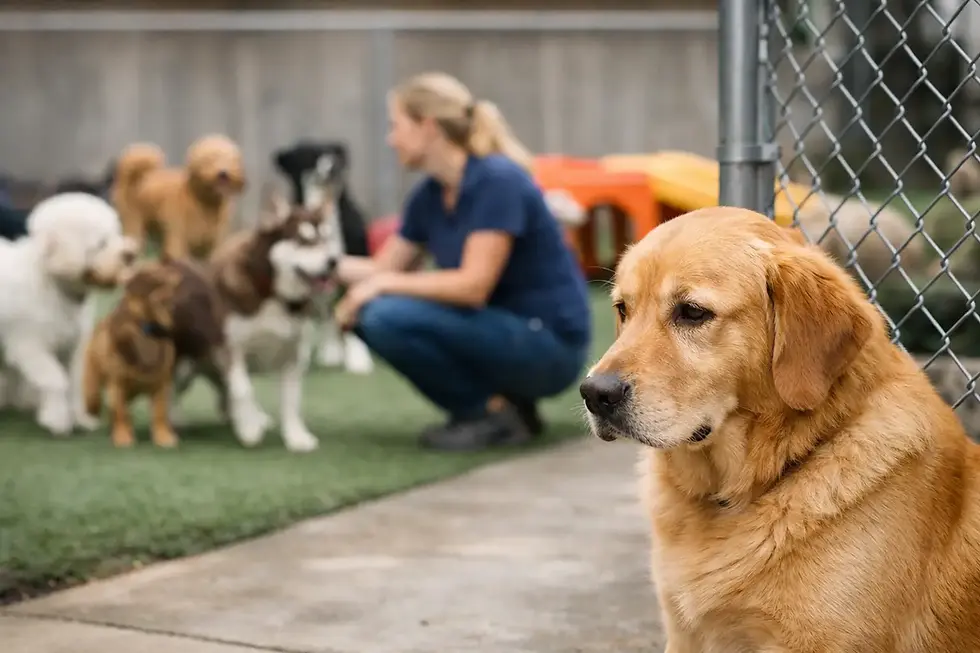
At BoneYard, supervised social time is about more than letting dogs loose. It is about giving them space to play, rest, reset, and enjoy their pack at a pace that feels good for them.
Stress Signals Are Early Warnings, Not Bad Behavior
Dogs often try to avoid conflict long before they growl, bark, or snap. Those quieter signals are worth celebrating because they give us a chance to help. Lip licking when no food is around, repeated yawning, sudden sniffing, turning the head away, lifting a paw, shaking off, or moving behind a person can all be signs that a dog needs a breather.
Panting is another one that depends on context. After a romp around an indoor dog park, panting is expected. Panting in a cool room while the dog is cornered by attention, paired with a tense face or restless pacing, may indicate stress. The question is not “Does my dog pant?” It is “What else is my dog showing me right now?”
Growling deserves the same respectful approach. A growl is communication, not a moral failure. Punishing it can teach a dog to skip the warning next time. Instead, calmly create distance, remove the pressure, and consider what triggered the response. Was the dog tired? Guarding a chew? Startled while resting? Uncomfortable with a stranger’s hand?
If behavior changes suddenly, especially in a dog who is usually social and easygoing, consider discomfort or pain as a possibility. A veterinary visit can rule out medical issues that training alone cannot solve.
Help Your Dog Feel Safer in Social Spaces
The best way to support your dog is to give them choices. Let them approach new people and dogs when they are ready. Avoid asking strangers to reach over their head or crowd their face. A side-on stance, a calm voice, and a tossed treat can feel much friendlier than an eager hand coming straight down.
Watch for whether your dog can take breaks. A dog enjoying a gathering may wander away for water, find a quiet spot near their person, or take a few minutes to observe. Those breaks are healthy. They do not mean your dog is antisocial or that the outing was a mistake.
Before a busy day of daycare, boarding, visitors, or a dog-friendly happy hour, consider your dog’s energy level and recent routine. A young, social dog may be thrilled by a lively afternoon. A senior dog, a newly adopted dog, or a dog recovering from a big week may prefer a shorter visit and a calmer corner. Good care is not one-size-fits-all. It is noticing who is in front of you.
When to Step In
Step in early when you see tension building. Call your dog away if play becomes one-sided, if either dog repeatedly tries to leave, or if bodies become rigid and fast-moving without pauses. Use a cheerful recall rather than grabbing collars in the middle of a tense moment whenever possible.
It also helps to advocate for your dog with simple, friendly language: “He needs a quick break,” “She prefers a little space,” or “Let’s let them sniff from here first.” You do not owe anyone an apology for protecting your dog’s comfort. Most fellow dog people appreciate the clarity.
The goal is not to decode every ear twitch perfectly. It is to stay curious, pay attention, and respond with kindness. When your dog learns that you notice their signals, they can relax a little more - whether they are napping at your feet, making a new pal, or wagging through the door to find their pack.


Comments