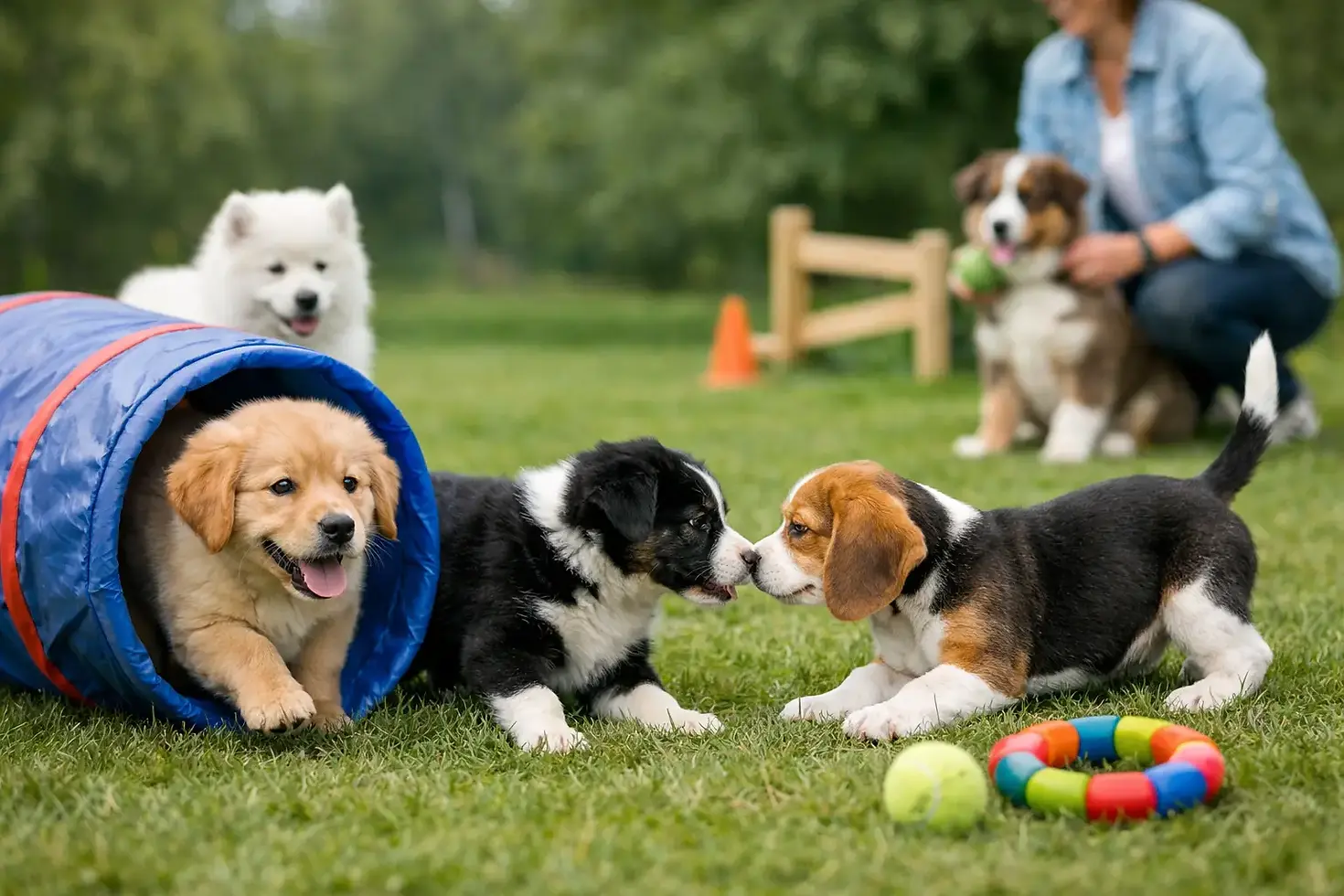
8 Puppy Socialization Games for Happy Dogs
A puppy who calmly watches a skateboard roll past, accepts a friendly hello, and settles beside your chair at a patio table is not necessarily “naturally easygoing.” More often, they have learned that new things can be safe, predictable, and even rewarding. That is what puppy socialization games are for: small, happy practice sessions that help your dog feel at home in a busy human world.
Socialization is not about introducing your puppy to every dog, person, and noise before a certain date. It is about giving them positive choices, protecting their comfort, and building confidence one treat-sized win at a time. For Seattle pups, that might mean a rainy sidewalk, a ferry horn, an elevator, a stroller, or a neighbor carrying an umbrella.
What Puppy Socialization Actually Looks Like
A well-socialized puppy is not required to love everything. Some dogs will always prefer a little personal space, and that is perfectly fine. The goal is a dog who can notice something unfamiliar, check in with their person, and recover without panic, lunging, or shutting down.
The best sessions are short and low-pressure. Keep treats handy, give your puppy an easy exit, and watch their body language. Loose muscles, a curious sniff, soft eyes, and a wagging tail usually mean they are comfortable enough to continue. Freezing, turning away, lip licking, tucked tails, repeated yawns, or a sudden refusal of treats can mean, “This is too much right now.” Add distance, lower the difficulty, or call it a win and head home.
There is a trade-off worth remembering: more exposure is not always better exposure. A crowded event may sound like great socialization, but a puppy who is overwhelmed can come away less confident. One calm stranger at the right distance often does more good than ten eager greetings.
8 Puppy Socialization Games to Build Confidence
1. Treat and Retreat Greetings
This game teaches your puppy that new people do not have to rush into their space. Ask a friend to stand several feet away, turn slightly sideways, and toss a treat behind your puppy. Your pup gets to move away, grab the treat, and decide whether they want to return closer.
Do not ask your friend to reach over your puppy’s head or insist on petting. The reward is not a forced hello. The reward is your puppy learning they have choices around people.
2. The Sound Snack Bar
New sounds can be startling, especially for puppies growing up around city traffic, delivery carts, coffee grinders, and apartment hallways. Make a simple sound playlist at a low volume, or use real-life sounds from a comfortable distance. Each time your puppy hears the sound, offer a tiny, tasty treat.
Start quieter than you think you need to. If your puppy perks up, takes the treat, and relaxes, you are in a good zone. If they bark, run, or cannot eat, turn the volume down or create more distance next time. The sound predicts snacks, not stress.
3. Find It on New Surfaces
Scatter a few treats on a clean, safe surface and say, “Find it.” Try grass, a rubber mat, a quiet sidewalk, a towel, a wooden deck, or a wobble-free platform. Sniffing helps many puppies settle, while gently exploring different textures builds confidence under their paws.
Keep the surface stable and skip anything slippery, hot, crowded, or unsafe. This is not an agility test. Let your puppy investigate at their own speed.
4. The Friendly People Parade
Set up a low-key rotation of people your puppy can observe: someone in a hat, someone using a cane, a neighbor with a tote bag, a calm teen, or a friend wearing a puffy raincoat. Have each person stay at a distance where your puppy remains relaxed, then pair the sight of that person with treats and praise.
Variety matters more than volume. Puppies benefit from seeing that people come in many shapes, voices, movements, and outfits. They do not need to greet every person to learn that those differences are normal.
5. Look at That
When your puppy spots another dog, cyclist, or passing stroller, calmly say, “Look at that,” then give them a treat for looking back at you. This game turns a potentially exciting moment into a check-in.
Choose your distance carefully. Across the street may be the right starting point for another dog, especially if your puppy is getting bouncy or worried. Socialization does not mean on-leash dog greetings with every passing pup. In fact, repeated leash greetings can create frustration for some dogs. Calm observation is often the better lesson.
6. Puppy Pass the Parcel
Use a lightweight box, a crinkly paper bag, or a new toy placed on the floor. Add a treat near it, then let your puppy approach, sniff, and move away as they please. Over a few sessions, place treats on top of the object, beside it, or just inside an open box.
The game is about curiosity, not bravery points. Never trap your puppy near an object or move it toward them for a reaction. If they hesitate, make it easier. Confidence grows when your puppy gets to be the one who investigates.
7. Settle Spot Practice
Bring a mat or small blanket to calm, dog-friendly places and reward your puppy for stepping onto it, lying down, and watching the world go by. Begin somewhere easy, such as your porch or a quiet park bench. Later, try a relaxed patio or a well-managed indoor dog space.
This is one of the most useful puppy socialization games because it teaches an overlooked skill: being social without being the center of the action. Your puppy can see people and dogs, enjoy a chew or a treat, and learn that hanging out quietly is part of the fun.
8. The Tiny Field Trip
Pick one new place and keep the visit brief. Sit in the car outside a busy store, watch a ferry from a comfortable distance, walk through a quiet lobby, or visit a clean facility with trained staff and age-appropriate puppy play. Bring high-value treats, stay for five to ten minutes, and leave while your puppy is still doing well.
At a community-centered spot such as BoneYard Seattle, ask staff about the best times and options for a young puppy. The right environment should prioritize cleanliness, supervision, compatible play styles, and breaks from the action. A puppy who needs a pause should never be expected to “work it out” in a crowd.
Make Every Game Easier to Win
Timing matters. Puppies are more likely to learn when they are rested, not hungry, and not already buzzing from an hour of activity. Keep sessions short, often just a few minutes, and end on a positive note. A cheerful “let’s go” before your puppy gets tired or worried is smart training, not quitting early.
Use treats your puppy truly loves, especially around bigger distractions. Kibble may work in your kitchen, while chicken or cheese may be more useful near a bustling sidewalk. Praise, sniff breaks, and a chance to move away can also be rewards, depending on what your puppy enjoys.
Be thoughtful about health, too. Young puppies may not yet be fully vaccinated, so ask your veterinarian which public spaces and dog interactions are appropriate for their age and vaccine status. You can still do plenty of safe socialization from your arms, a stroller, the car, your home, or controlled visits with healthy, vaccinated dogs.
When to Get a Little Extra Help
If your puppy regularly trembles, growls, snaps, hides, or cannot recover after seeing ordinary sights and sounds, do not punish the behavior. Those signals are useful information. Speak with your veterinarian and a qualified, reward-based trainer who can help you create a plan that fits your puppy rather than pushing them past their limits.
The same goes for overly enthusiastic puppies. A dog who races toward every person or dog is not necessarily “just friendly.” They may need practice with calm observation, polite greetings, and settling nearby. Good social skills include knowing when not to say hello.
Your puppy does not need a packed calendar to become a confident companion. Give them a few kind, manageable moments each week, celebrate the tiny victories, and let their comfort set the pace. Before long, those everyday moments - a new face, a strange sound, a busy sidewalk - can become another reason to wag a tail and stay close to the pack.


Comments