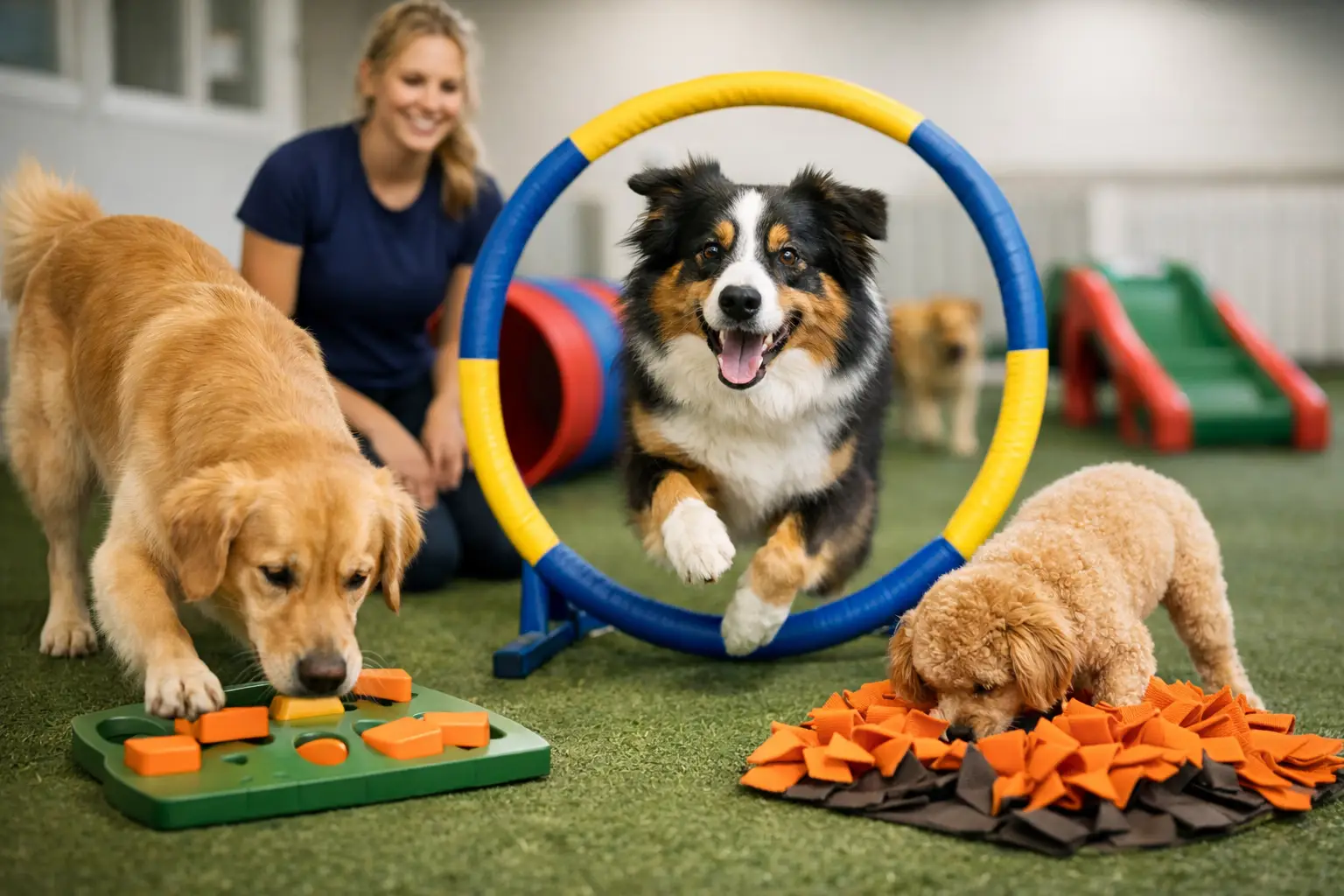
Dog Enrichment During Daycare That Dogs Love
The best daycare pickup is not the one where your dog can barely keep their eyes open. It is the one where they come home pleasantly tired, settled, and ready to curl up beside you after a day that felt good. Dog enrichment during daycare is what helps turn a busy day away from home into more than just time spent around other dogs.
For city pups, a satisfying day needs more than an open play space. It needs variety, thoughtful pacing, opportunities to use their senses, and room to choose a breather when the action gets big. That is how a good daycare day supports a dog’s body, brain, and social life all at once.
What dog enrichment during daycare really means
Enrichment is any activity or environment that gives a dog a healthy outlet for natural behaviors. Sniffing, moving, solving a simple challenge, resting near friends, chewing, exploring new textures, and engaging with a trusted person can all count.
At daycare, enrichment should not feel like school, and it should never be a one-size-fits-all schedule. A confident, high-energy young dog may light up during a movement game or a chance to chase and play. A more reserved pup may get just as much from a calm sniff-and-search activity, a cozy reset, or gentle interaction with a staff member.
The goal is not to keep every dog busy every second. In fact, constant stimulation can leave some dogs overtired or overwhelmed. The goal is a balanced day with moments of play, connection, curiosity, and rest.
Why play alone is not always enough
Dog play is valuable. It builds social skills, burns energy, and can be pure joy. But even dogs who love a good romp benefit from breaks in the action. Think about a crowded happy hour: fun is better when there is room to step aside, catch your breath, and rejoin when you feel like it.
Dogs communicate their needs in quieter ways than we sometimes expect. A dog may wander to the edge of the group, shake off, take a long drink, or choose to sit near a person rather than jump back into play. Those moments are not a failure to participate. They are useful information.
Thoughtful enrichment gives staff more ways to meet dogs where they are. It can help redirect a pup who is getting too amped up, invite a shy newcomer into a low-pressure activity, or give a regular daycare guest something fresh to look forward to. A well-paced day is often more satisfying than a nonstop one.
The kinds of enrichment that make a daycare day better
Sensory time lets dogs use their noses
Dogs experience the world nose first. Sniffing games, scent-based searches, and rotating safe items with new smells can offer a meaningful mental workout without requiring a huge burst of physical energy. For a dog who has been playing hard, this kind of activity can be a lovely change of pace.
Sensory enrichment is especially helpful for dogs who are more observant than rowdy. Not every pup wants to be the life of the party, but nearly every pup enjoys getting information through their nose.
Movement has more than one speed
A game of chase might be a perfect fit for one group, while another group may enjoy climbing, weaving, exploring, or simply strolling through a thoughtfully arranged space. The best movement activities account for size, play style, confidence, age, and energy level.
Young dogs may need help learning when to pause. Older dogs may still enjoy activity but prefer lower-impact options and a softer pace. Daycare is at its best when a dog can move in ways that feel comfortable rather than being expected to match the loudest dog in the room.
Simple problem-solving builds confidence
Treat puzzles, food-dispensing toys, scatter feeding, and easy find-it games can give dogs a chance to work for something rewarding. These activities should be introduced safely and with the right level of supervision, especially in a group setting.
The challenge matters, but so does the win. If an activity is too difficult, it can frustrate a dog. If it is too easy every time, it may lose its sparkle. Small, achievable puzzles are often the sweet spot, particularly for dogs still learning how to settle their excitement.
Calm connection counts too
Enrichment is not always an object or a game. A calm check-in from a trained caregiver, a quiet place to decompress, or a chance to hang out near a familiar friend can be deeply valuable.
This is one reason trained staff matter so much. They can notice when a dog is asking for play, when they are asking for space, and when they may benefit from a reset. The safest, happiest daycare environments treat rest as part of the experience, not time between the fun parts.
Good enrichment starts with good group management
No toy or activity can make up for a poorly matched playgroup. Before enrichment even begins, dogs need to be grouped and supervised with care. Compatible play styles, appropriate energy levels, clean spaces, and attentive handlers set the stage for dogs to relax enough to enjoy themselves.
It also depends on the dog. Some pups thrive in a bustling social group. Others do best with a smaller circle, shorter play sessions, or more individualized downtime. A quality daycare should be comfortable making adjustments rather than assuming every dog needs the same kind of day.
At BoneYard Seattle, that pack-minded approach fits naturally with the bigger idea of a dog-friendly neighborhood gathering place: dogs deserve care that feels personal, while their people get the confidence of knowing their best friend is in good hands.
What to ask before choosing daycare
You do not need a long checklist to spot whether a daycare takes enrichment seriously. Start by asking how the team learns each dog’s play style and comfort level. Then ask how they handle rest, whether dogs get activities beyond open play, and how staff recognize when a dog needs a break.
You can also ask how the facility introduces new activities and manages resources such as treats or toys around groups. Safety protocols matter here. Enrichment should add enjoyment, not competition or stress.
Pay attention to how the team talks about dogs. Do they describe every dog as needing to be tired out? Or do they talk about pacing, personality, social comfort, and individual needs? The second answer is usually a better sign.
How to help your dog get more from daycare
Your own observations are useful. Tell the daycare team what makes your dog light up at home, whether that is a favorite scent game, a gentle game of tug, a chewy treat, or simply a sunny nap near people. Mention any sensitivities, guarding behaviors, mobility concerns, or situations that tend to make your dog nervous.
After daycare, watch the whole evening rather than judging only the first five minutes. A fulfilled dog may sleep deeply, but they should also be able to settle comfortably. If your dog seems unusually wired, excessively thirsty, sore, or unable to calm down, share that feedback. It may mean the day needs more rest, a different group, or a gentler pace.
Consistency helps, too. Regular attendance can give dogs time to build familiarity with staff, routines, and canine friends. But even social butterflies need recovery days. Daycare two or three times a week may be ideal for one dog, while another does beautifully with a different rhythm.
A great daycare day leaves a dog with more than a full tank of playtime. It gives them a chance to be curious, social, supported, and safely themselves. That is the kind of care that makes the ride home feel like the happiest part of a very good day.


Comments